


cape snake conservation logo
  • Home
  • About
  • Snake Removal Service Cape Town
  • Western Cape Snakes
    • Venomous
      • Berg Adder
      • Boomslang
      • Cape Cobra Snake Information and Identification Guide
      • Cape Coral Snake
      • Puff Adder
      • Rinkhals
    • Non-Venomous Snakes
      • Mole Snake
  • Research
    • Rinkhals Research
    • Cape Town Snake Survey
      • Snake Sightings
  • Products & Services
    • Snake Leg Protection
    • Recommended Books
  • Make a Donation

Search this site

Get Your FREE eBook
Venomous snakes of Cape Town, Snakebite Emergency & More...

Merch :)

Epic Snake Fight

https://youtu.be/LMWLYccoV0A

Snake Schwag

Snake Strikes Camera

https://youtu.be/fu9czc82NwI

Join the Community!

Patreon Cape Snake Conservation

Snake Guardz

Snake gaiters

Popular Posts

Cape Cobra VS Mole Snake
72 Comments
5 Reasons Why Getting Rid of Snakes is a BAD Idea
42 Comments
Watch this boomslang move!
35 Comments
Snake in Your House! Who Pays?
31 Comments
Snakes Don’t Chase Humans (Wait until you see the proof).
30 Comments
Cape Cobra Identification Made Easy
19 Comments
The Ultimate Cobra Snake Facts Guide
18 Comments
Deadly Cape Cobra Bite Attempt - Snake Strike!
15 Comments
Fear of Snakes: Learned or Genetic?
11 Comments

Recent Posts

  • What to do if You See a Snake
  • Snake Catcher Diaries: Are Snake Catchers Crazy or Not?
  • Getting Whipped - by a Karoo Whip Snake!
  • Even Snakes Get the Blues
  • Watch this boomslang move!

Like us on Facebook!

Recommended Websites

  • Cape Reptile Institute
  • Helderberg Snake Removals

Archive for Callouts

Even Snakes Get the Blues

By Grant
Thursday, February 9th, 2017

Even Snakes Get the Blues [Full video at the end of the post]

WARNING: This video contains footage that should never be tried anywhere if you haven’t had the appropriate training. Never try to capture (or kill) a snake yourself as a mistake could have fatal consequences.

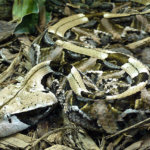
This was the second attempt at catching this snake. The puff adder is a potently venomous front-fanged (hinged) snake occurring in most of sub-Saharan Africa.

The puff adder, along with the Cape cobra and boomslang,  is a relatively common venomous snake in Cape Town which regularly comes into contact with people, particularly those that live adjacent to the Table Mountain National Park.

In this specific case, the snake found itself a perfect home at the bottom of a garden. Compost heaps, leaf piles, concrete slabs and large logs made for ideal snake retreats.

It managed to escape me once before. However, on this occasion the gardener William watched the snake with eagle eyes and was able to lead me right to its hideout.

It was a tricky capture, but I manged to ease it out from under the large log and place it in my capture container. It was “in the blues” which is an intermediate stage of ecdydis - the process whereby a snake sheds off an old layer of skin. This period of reduced eyesight is an incredibly vulnerable time for a snake.

The staff at the house were nervous but fascinated. It was great to capture some of this educational dialogue on video before releasing the snake in suitable habitat on the mountain above.

The only time the snake became edgy was during the release. It puffed loudly and got into strike pose. But even so, with a little coaxing it sped off into the undergrowth. Doing what snakes always prefer to do - take flight before fight.

If you enjoy my work, please consider supporting me on Patreon.

www.patreon.com/capesnakeconservation

Categories : Callouts, Education, Snake Awareness, Venomous
Tags : callouts, Cape Town, puff adder, snakes, venomous

Watch this boomslang move!

By Grant
Tuesday, January 17th, 2017

I caught a beautiful male Boomslang close to Clifton 1st beach. If you’ve ever wondered how quickly these snakes can move then you don’t want to miss this  

Boomslang are usually relatively placid and inoffensive snakes. In fact, many people have lived with boomslang in their gardens and roofs for years without issues. This particular snake, while not striking once, was clearly a little distressed and very alert. 

I’m always amazed at just how quickly boomslang move through the trees. They really are a masterpiece of evolution and I feel privileged to be able to get sightings like this one.

Please let me know if you enjoyed this one by leaving a comment below 🙂

Categories : Callouts, Identification Videos, Snake Awareness, Venomous
Tags : boomslang

Killing a Snake in the Western Cape is Illegal (Sometimes)

By Grant
Wednesday, October 3rd, 2012

The legislation around the killing of snakes in the Western Cape is a bit of a grey area. On one hand only the following snakes are formally protected:

  • Water Snakes (Genus Lycodonomorphus)
  • House Snakes (Genus Lamprophis)
  • Wolf Snakes (Genus Lycophidion)
  • File Snakes (Genus Mehelya)
  • Slug-eaters (Genus Duberria)
  • Egg-eaters (Genus Dasypeltis)
  • Mole Snakes (Genus Pseudaspis)
  • Green and Bush Snakes (Genus Philothamnus)
  • Shovel-snout Snakes (Genus Prosymna)

So killing any of these snakes in the Western Cape is illegal. Technically this would mean that any species (mostly venomous snakes) not listed is an unprotected one. However, according to the nature conservation ordinance (Ordinance 19 of 1974) snakes are wild animals and nobody may hunt, kill, capture wild animals without special permission.

This in theory is good news for snakes but it is a law which is not often followed. It is also one which could easily be misread if the first document is read in isolation. In fact there are many who believe that it is not only OK but permitted to kill or capture a snake if it is on their property (which in part is true - keep reading).

UPDATE: An explanation from CapeNature

  1. The Ordinance only has a limited list of protected snakes in the Schedules. However, the definition of protected wild animal also includes animals listed on CITES Appendix II, which includes all pythons. CITES Appendix I listed animals are deemed to be endangered wild animals by the Ordinance. Cape cobras and puff adders are considered to be so-called “unprotected wild animals”.
  2. Section 14 of the Ordinance states that no wild animal may be hunted on a local authority nature reserve without the written permission of the local authority concerned. This is punishable with a fine of up to R100 000 or 10 yrs imprisonment.
  3. The Ordinance definition of the word “hunt” is also important when considering such matters. The Ordinance definition for hunt includes to kill or to capture.
  4. The protection status of the animal determines the documentation required to legally hunt said animal
    1. A permit is required to hunt endangered wild animals. These permits are not often issued.
    2. A hunting license is required to hunt protected wild animals within a proclaimed hunting season. A permit is required to hunt a protected wild animal outside the proclaimed hunting season or is there is no proclaimed hunting season for such protected wild animal.
    3. In order to hunt an “unprotected” wild animal, the written permission of the landowner is required, if one is using a method that is not listed in section 29 as a prohibited hunting method.
    4. In order to make use of a method listed in s. 29 of the Ordinance as a prohibited hunting method, one must obtain a permit from CapeNature.
    5. The owner of any land is permitted to hunt a wild animal on the property of which he/she is the owner. This permission to hunt is still limited by the methods used (as per s. 29 of the Ordinance).
    6. Many of the traditional methods of capturing snakes fit the definitions of methods listed in s. 29 of the Ordinance (e.g. snake tongs fit into the definition of snare) and therefore permits are required for the legal use thereof.

This is a very general overview of the situation and each case must be judged on its merits.

Section 29 of the Ordinance States:

29. Prohibited ways of hunting.—No person shall unless he is the holder of a permit

authorising him to do so, hunt any wild animal—

(a)

by means of fire or poison;

(b)

with the aid of artificial light;

(c)

on or from a public road;

(d)

by means of any trap;

(e)

during the period one hour after sunset on any day and one hour before sunrise on

the following day;

( f )

by means of any weapon in a public place within the area of jurisdiction of a local

authority;

(g)

by means of a fire-arm which discharges a rim-fire cartridge of a calibre less than

five comma six millimetres;

(h)

by means of a fire-arm which discharges more than two shots without being

manually reloaded;

(i)

by means of a bow-and-arrow;

( j)

by means of a set gun or any similar contrivance;

(k)

by means of any device which injects an intoxicating or a narcotic agent or poison

into such animal;

(l)

by the use of a dog, except for the hunting of birds or for the purpose of following

or searching for any such animal which has been wounded;

(m)

in the case of birds in or upon inland waters, by the use of a boat for the purpose of

chasing or killing such birds;

provided that in respect of the hunting of—

(i)

rodents, the provisions of paragraphs (a), (b), (d), (e) and (l), or

[Sub-para. (i) amended by s. 7 of Ord. 26 of 1986.]

(ii)

any bird or any other wild animal which is not an endangered or a protected wild

animal, the provisions of paragraph (g), or

(iii)

any such wild animal by a registered veterinary surgeon in the practice of his

profession, the provisions of paragraph (k),

shall not apply.

The short of it is that if a snake is on a private land then the landowner may in fact kill the snake, or give permission to kill the snake as long as neither are using a prohibited method as in s. 29. This means that one can kill a snake by use of a heavy object for example but not permitted to capture it in a box (trap) without a permit (there is a hole here which needs some revision I think). If the “unprotected animal” is on a local authority nature reserve then “hunting” the animal, or snake in this case, is heavily punishable.

Many of us doing call-outs in our spare time have experienced this; rushing out to retrieve a snake only to find it dead, or injured. I understand the thought process, the fear, the idea that if the snake isn’t dealt with it is either going to return or bite a child or a dog. And of course this does happen but can often be avoided.

One of the biggest challenges we face conserving the snakes of the Western Cape is trying to get people to understand that snakes will not bite without provocation. That biting something much larger than themselves is usually a last ditch attempt at survival.

This is not to say that people who kill snakes are wrong; they are usually only displaying the very same behaviour that a snake is when it strikes out of fear. I would also never advocate that in these instances that anyone who kills a snake be prosecuted - but the legislation is there and if anything, it could possibly help to assist in making a targeted decision from hitting the reptile with a stick or simply keeping a close eye on it and phoning a snake handler for snake removal.

It’s confusing, but killing a snake in the Western Cape is illegal, sometimes.

Would you kill the snake or phone one of us? Should all snakes be protected or should it be OK to kill the venomous ones?


Like What You Read?

Sign Up for Email Updates - FREE!!

Categories : Callouts, Snake Awareness

I’ll Never Understand Animal Cruelty

By Grant
Thursday, December 8th, 2011

It’s not easy to figure out exactly what happened to this snake but here are some things I noticed:

Mouth full of blood, internal bleeding and ruptured organs towards head (heart and lungs). Scuffed ventral (underside) scales in an area about 20cm wide.

Then there is the string tied tightly around the body. Maybe the snake was hit by a car then half alive was noosed out of curiosity or, the noose had a direct impact on its death or, the noose was put on after the snake was already dead. Either way it looks like there was some foul play involved.

I opened this snake up to see what it had been eating and found two fresh Cape golden moles in its gut. This big boy almost hit a total length of 2 metres (virtually max size in the Cape) and has probably been helping Tamboerskloof garderners for well over a decade.

In the final picture (apologies for poor quality and random baby bottle) you can see the area of damage in the upper half of its body behind the noose. In the end it doesn’t really matter how it happened - it’s a terrible way to go.

Categories : Callouts, Snake Awareness

There’s a cobra in my house and it’s killed my cat!!

By Grant
Thursday, November 3rd, 2011

These were the last words spoken to me over the phone by an understandably distraught woman before I sprung into my car and made my way towards her house. Snake callouts are potentially exciting, depending on the type of snake, its size and where it has managed to hide itself. But after hearing the potential consequences of this call, a dead pet, I had mixed feelings as I made my way up Table Mountain’s winding residential roads, heading towards the top of Kloof Nek.

Usually callouts offer the perfect opportunity to dispel some of the fears that people have about snakes, but how was I going to try to convince this family that this snake does not mean any harm. That it only bites for food or self-defence? I was a little confused that they actually called me to help them. If one does have an innate belief that snakes are evil creatures then surely the death of a beloved animal would be reason enough to unleash an equal fate on the evil doer. At any rate, this seemed like it was going to be a challenge.

Ten minutes later I arrived, snake stick in one hand, capture box in the other and was greeted at the front door by the woman who had made the call. Her husband came down the stairs and recalled the chain of events which had led them to believe that the snake had bitten their cat. The cat was still missing and the last time they had seen her it had bolted past them hissing, as if frightened or in pain.

The woman and her son had put a box over the snake and placed heavy books on top in order to weigh it down, preventing the snake’s escape. Both her and her son claimed they had seen the snake make a hood before they covered it. Certainly sounded cobra-like. But fear can have interesting effects on the mind and activate the imagination.

Prepared for something venomous I removed the books weighing down the box and slowly lifted it on one side to view the snake underneath. As I peered under, to my surprise, I saw…nothing. Oh wait, there was something but it was so incredibly small.

This freshly hatched common brown water snake (Lycodonomorphus rufulus) had caused quite a stir in the house, but this non venomous animal certainly wasn’t responsible for any missing cats . I put the snake on my hand and asked the woman if there was a water source nearby. Of course! I thought, as it was explained that there was a perennial stream running straight through the property - perfect as these snakes feed on frogs and their tadpoles. I walked down the road, away from their other on looking cats one of which, in all likelihood, had brought the little snake in as a play thing. I found where the stream passed under the road and released the snake which slithered out of sight underneath some plants next to the stream.

When I returned to my car I heard a call from the front door. “We found our Cat! She’s busy having her dinner!” Grinning, I replied. “I’m so happy to hear that!” I was. No dead cat, no dead snake.

Categories : Callouts
Cape Snake Conservation
Copyright © 2018 All Rights Reserved
iThemes Builder by iThemes
Powered by WordPress