



Background
There is no evidence to suggest that the rinkhals, Hemachatus haemachatus, is declining as a species. However, in the Western Cape and particularly in the Cape Metropolitan area, the picture is somewhat different.
In the early half of the 20th century accounts from naturalists such as Laurence Wingate indicate that the rinkhals was once a common species on the Cape Flats. However, somewhere between 1950 and 1967 Wingate mentions that the rinkhals was nearing extinction in the very area that it was once thought to be common.
In the second half of the 20th century rinkhals records were few and far between and until recent times anecdotal reports suggested that the rinkhals could still be found at the Kenilworth and Kilarney Racecourses.
However these last havens have come under increased pressure by developers and the last rinkhals recorded at any of these sites was by Sean Thomas at Kenilworth Racecourse in 2002.
Although there has been extensive development in the City during this time, this alone cannot account for the apparent decline where there are still many areas of suitable habitat especially within the Table Mountain National Park.
Countrywide, the rinkhals has been recorded from as low as sea level to altitudes of up to 2 500 metres. However, in the Cape Peninsula the rinkhals was previously only recorded from the coastal areas. Could it be that this species was overlooked? Perhaps records were lost? Maybe the climatic conditions on the peninsula restricted the species to the lowlands?
In the north-eastern parts of its range, particularly around Johannesburg, the rinkhals is still one of the most common snakes encountered, despite urban sprawl. One factor there however is the absence of the Cape cobra. Cape cobras and rinkhals both eat other snakes. Could this have something to do with it?
Many questions, few answers.
Initial Stages
In 2008 the rinkhals were thought to have been lost from the Cape as they had not been recorded within the City metro for over 10 years.
But snakes are naturally difficult to study and simply not observing a species in an area does not always prove that its absence.
The search began with field surveys at both the Helderberg and Steenbras Nature reserves, hoping to actively find a rinkhals while using additional data acquired to determine the detection probability of the common snakes in the area.
In order to guide these searches a flyer was developed along with the City of Cape Town’s communications department. This proved to be a great success for a number of reasons:
- It allowed us to gauge people’s general knowledge of local snakes
- It created awareness regarding snakes, the plight of the rinkhals and informed the public that there was a means to deal with ‘problem’ snakes safely
- It involved members of the public and effectively formed a ‘data bridge’ which ultimately proved the existence of the species within the Cape metro
- It continues to serve as a reference for further records emanating from the Western Cape
Findings
The preliminary results of the study found conclusively that the Cape metro is still home to the rinkhals. However, it is still unclear to what extent and whether or not these populations are stable or declining. The study confirmed individuals in the east of the City with confirmations coming from Gordon’s Bay, Somerset West and the Steenbras Nature Reserve.
Unfortunately it appears that the rinkhals may be lost in the areas on the Cape flats at sites where they were previously recorded. However, groups of sightings from the Table Mountain range sparked new interest in the possibility of unknown populations of this species on the Cape peninsula itself.
The Way Forward
- Continued awareness
- Source funding
- Once there are funds for research to progress, intensify surveys in an attempt to answer questions on:
- Populations densities
- Home ranges
- Diet (does it differ regionally)
- Ecology - competition, predation
- Detection Probabilities
- Habitat preferences
Conclusion
The rinkhals research ‘citizen science’ stage of this project has to date been a great success and I would once again like to thank all who participated in some shape or form.
We do not know if there is any form population decline. Although in dealings with farmers and government staff in Grabouw, in areas of good habitat, the general consensus is that this species is not seen as often as it was in the past. On the Cape flats the reasons are obvious and common - habitat destruction.
But if there is a decline, and if there are factors unknown to us affecting this species, then we need to find answers sooner than later.
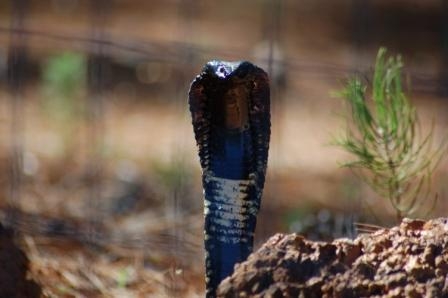
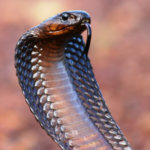
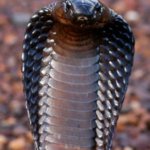
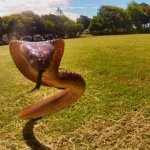
Below is a gallery of images sent in by our rinkhals ‘citizen scientists’. Enjoy!
Gallery (click to enlarge)